
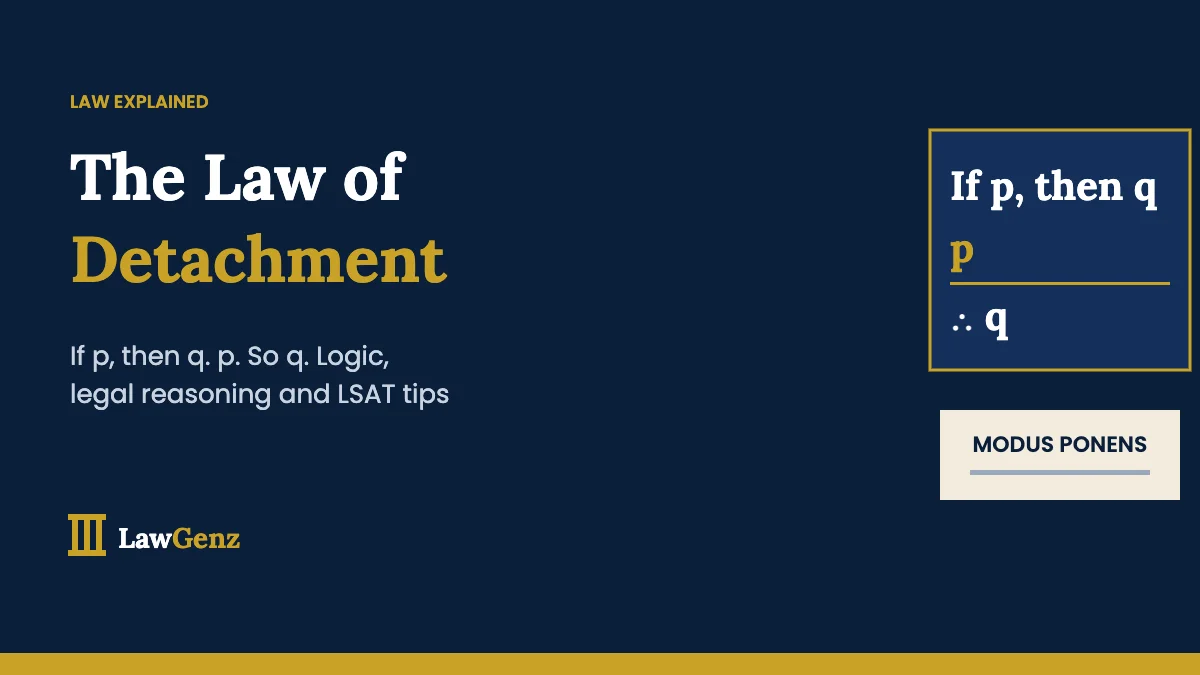
The law of detachment is a rule of logic that says if “If p, then q” is true and p is true, then q must also be true. Logicians call it modus ponens, and geometry students learn it as a basic proof tool. However, it matters far beyond math class. Lawyers use the law of detachment every time they apply a rule to a set of facts. Judges use it to reach decisions. Likewise, the LSAT tests it in its Logical Reasoning questions. In this guide, you will learn the plain meaning, the symbolic form, and clear everyday and legal examples. You will also see common look-alike errors, how the rule fits into IRAC, and where it breaks down. Finally, you can test yourself with three practice questions.
| Quick Fact | Details |
|---|---|
| Also called | Modus ponens, affirming the antecedent, direct reasoning |
| Symbolic form | p → q; p; therefore q |
| Type of reasoning | Deductive (the conclusion follows with certainty) |
| Where you see it | Geometry proofs, logic courses, legal analysis, the LSAT |
| Common mistake | Affirming the consequent (q is true, so p is true) |
| Legal use | Rule + facts → conclusion, the core of IRAC |
What Is the Law of Detachment?
The law of detachment says that when a conditional statement is true and its “if” part is true, its “then” part must be true too. You “detach” the conclusion from the conditional and state it on its own.
Every conditional has two parts. The “if” part is the hypothesis, or antecedent. The “then” part is the conclusion, or consequent. For example, in “If it rains, then the game is canceled,” rain is the antecedent and the canceled game is the consequent. So if you know it is raining, you can conclude the game is canceled.
Notably, this is deductive reasoning. If both premises are true, the conclusion cannot be false.
The Symbolic Form of the Law of Detachment
In symbols, the law of detachment looks like this: p → q, p, therefore q. The arrow means “if…then,” and ∴ means “therefore.” The LibreTexts open textbook on logical arguments shows the same pattern with truth tables.
You can check any argument against the pattern with these steps:
- Find the conditional statement and write it as “If p, then q.”
- Label the antecedent (p) and the consequent (q).
- Check whether the second premise states that p is true.
- If it does, conclude that q is true.
- If the second premise states that q is true instead, stop. That is a different and invalid pattern.
Everyday and Legal Examples
The rule works the same way whether the topic is homework or a statute. Here are three examples that follow the valid pattern.
- Geometry: If an angle measures 90 degrees, then it is a right angle. Angle B measures 90 degrees. Therefore, angle B is a right angle.
- Traffic statute: If a driver exceeds the speed limit, then the driver commits a traffic violation. Dana drove 70 mph in a 55 mph zone. Therefore, Dana committed a traffic violation.
- Constitutional rule: If a person is under 35, then that person cannot serve as U.S. president. Sam is 30. Therefore, Sam cannot serve as president.
In each case, the second premise matches the “if” part exactly. Rules at every level, from local codes to the supreme law of the land, can feed this kind of reasoning.
Invalid Look-Alikes and Related Rules
Two common errors look like the law of detachment but are invalid: affirming the consequent and denying the antecedent. Meanwhile, two related rules are valid: the law of syllogism and modus tollens.
For instance, a driver can commit a violation by running a red light without speeding. So a violation alone does not prove speeding.
| Pattern | Form | Valid? | Example |
|---|---|---|---|
| Law of detachment (modus ponens) | p → q; p; ∴ q | Yes | She sped, so she committed a violation. |
| Law of syllogism | p → q; q → r; ∴ p → r | Yes | If you speed, you get a ticket; if you get a ticket, you pay a fine; so if you speed, you pay a fine. |
| Modus tollens (law of contrapositive) | p → q; not q; ∴ not p | Yes | She committed no violation, so she did not speed. |
| Affirming the consequent | p → q; q; ∴ p | No | She committed a violation, so she sped. |
| Denying the antecedent | p → q; not p; ∴ not q | No | She did not speed, so she committed no violation. |
How Lawyers and Judges Use the Law of Detachment
Legal reasoning often follows the law of detachment: a rule states a condition, the facts meet that condition, and the legal result follows. This structure sits at the heart of IRAC, which stands for Issue, Rule, Application, and Conclusion.
In IRAC, the rule is the conditional (p → q). The application shows that the facts satisfy p. Then the conclusion states q. This works in both criminal and civil cases, though the stakes and burdens differ, as our guide to civil vs. criminal law explains.
However, real cases rarely stay this neat. The logic is only as strong as its premises, and lawyers often fight over those premises:
- Disputed facts: The parties may disagree about whether p happened at all. Evidence decides that, not logic.
- Ambiguous rules: Words like “reasonable” or “vehicle” can have more than one meaning. If the rule is unclear, the conditional itself is uncertain.
- Exceptions and defenses: Many rules carry exceptions. For example, an emergency vehicle may lawfully exceed the speed limit. So the real rule reads “If p and no exception applies, then q.”
In short, the law of detachment guarantees a valid structure, not a true conclusion. This article explains logic and does not offer legal advice about any specific situation.
LSAT Tips for Conditional Reasoning
The LSAT does not name the law of detachment, but its Logical Reasoning questions test conditional logic often.
As of 2026, the LSAT has four 35-minute multiple-choice sections: two scored Logical Reasoning sections, one scored Reading Comprehension section, and one unscored section. LSAC removed the Analytical Reasoning section, often called Logic Games, starting with the August 2024 test. You also complete a separate, unscored LSAT Argumentative Writing essay. Check the LSAC Logical Reasoning overview for the official description.
- Translate the words. “If,” “when,” and “all” usually introduce the antecedent. “Only if” introduces the consequent.
- Diagram quickly. Write each rule as an arrow, such as A → B.
- Look for flaws. Flaw questions often hide affirming the consequent or denying the antecedent.
- Use the contrapositive. A → B also means not B → not A. Nothing else follows automatically.
Practice Questions
Question 1
If a tenant pays rent late, then the tenant owes a late fee. Maria paid rent late. What follows? Answer: Maria owes a late fee. This is a valid use of the law of detachment.
Question 2
If a person is a lawyer, then the person passed a bar exam. Jordan passed a bar exam. Is Jordan a lawyer? Answer: Not necessarily. This argument affirms the consequent, so it is invalid.
Question 3
If a store is open, then the lights are on. The lights are off. What follows? Answer: The store is not open. This is modus tollens, a valid form.
Conclusion
The law of detachment is simple: if “If p, then q” is true and p is true, then q is true. It powers geometry proofs, shapes the IRAC method, and shows up across LSAT Logical Reasoning. Above all, remember its limits. A valid form cannot fix a false premise, a disputed fact, or an unclear rule. For more plain-English guides, browse our Law section.
Frequently Asked Questions
Is the law of detachment the same as modus ponens?
Yes. Both names describe the same valid pattern: p → q, p, therefore q.
What is the difference between the law of detachment and the law of syllogism?
The law of detachment uses one conditional and a fact to reach a conclusion. By contrast, the law of syllogism links two conditionals (p → q and q → r) into a new conditional (p → r).
Why is affirming the consequent invalid?
The consequent can be true for other reasons. For example, a wet street does not prove it rained, because a sprinkler could have caused it.
Does the law of detachment prove a conclusion is true?
Only if both premises are true. The rule guarantees a valid structure. If a premise is false, the conclusion may be false too.
Is the law of detachment on the LSAT?
Not by name. However, LSAT Logical Reasoning questions often test if-then logic, including valid forms and common flaws.
Sources
- LSAC, “Logical Reasoning,” lsac.org
- LSAC LawHub, “About the Test Format and Testing Interface,” lawhub.org
- LibreTexts Mathematics, “Logical Arguments,” math.libretexts.org
- University of Illinois Pre-Law Advising, “LSAT Updates: Changes Beginning August 2024,” prelaw.illinois.edu